Real Estate SEO
SEO for Real Estate: A Practical Guide for Agents
TL;DR: SEO for real estate is the practice of optimizing a property website so it ranks in organic search when buyers and sellers look for agents, listings, and neighborhoods. It combines local SEO, keyword-targeted content, technical health, real estate schema markup, and ongoing monitoring. Done well, it turns search into a steady lead source instead of a one-time push. This guide covers the full manual playbook first, then shows how to keep those gains from quietly eroding as your listings change.
SEO for real estate is how an agent, brokerage or property firm get visibility in organic search result. So the right buyers find their listings before they reach competitor. It matters because search is where the home buyers journey begin.
Recent NAR data shows nearly all buyers under 60 use the internet during their home search, and the overwhelming majority still complete the purchase with an agent they can find and trust. Ranking well is how you get in front of that search before someone else does.
The work splits cleanly into two parts. First, the manual strategy that gets you ranking. Second, the ongoing monitoring that keeps you there as listings sell, pages change, and technical issues creep in. We will walk through both.
According to the National Association of Realtors 2025 Profile of Home Buyers and Sellers, 88% of buyers purchased through an agent or broker, and the internet remains the tool nearly every buyer uses to start the search. That is the exact moment real estate SEO is competing for.
What is SEO for real estate?
Those terms range from broad ("homes for sale in [city]") to highly specific ("3 bedroom condo near [school district]"). Unlike paid ads, organic rankings are not switched off when the budget runs out, which is why SEO compounds into a durable lead channel over time.
SEO for real estate is the set of on-page, technical, and local optimization strategies that help a property website rank in organic search results for specific keywords that buyers and sellers search for.
These keywords can range from broad terms like:
- “homes for sale in [city]”
- “homes for sale under [price]”
to more specific terms like:
- “3-bedroom condo near [school district]”
- “2-story home near [train station]”
Real estate is one of the most local, most competitive, and most technically demanding niches in search. Listings turn over constantly, portals dominate the biggest keywords, and trust signals carry unusual weight because buyers are making one of the largest decisions of their lives. That combination rewards agents who treat SEO as an ongoing discipline rather than a one-time setup.
The manual real estate SEO playbook
Everything in this section is work you can do yourself, and it stands on its own. If you complete it properly, you will have a genuinely optimized real estate website.
1. Research local and long-tail keywords
Start with how your clients search, not how you describe your services. Buyers rarely type "residential real estate professional." They type :
- "homes for sale in [neighborhood],"
- "best realtor in [city],"
- "condos under 400k [area]."
Build a list around three buckets: transactional local terms, neighborhood and school-district terms, and question-based long-tail phrases. Long-tail keywords carry less volume but far less competition, so they are the fastest route to first-page rankings for a newer site.
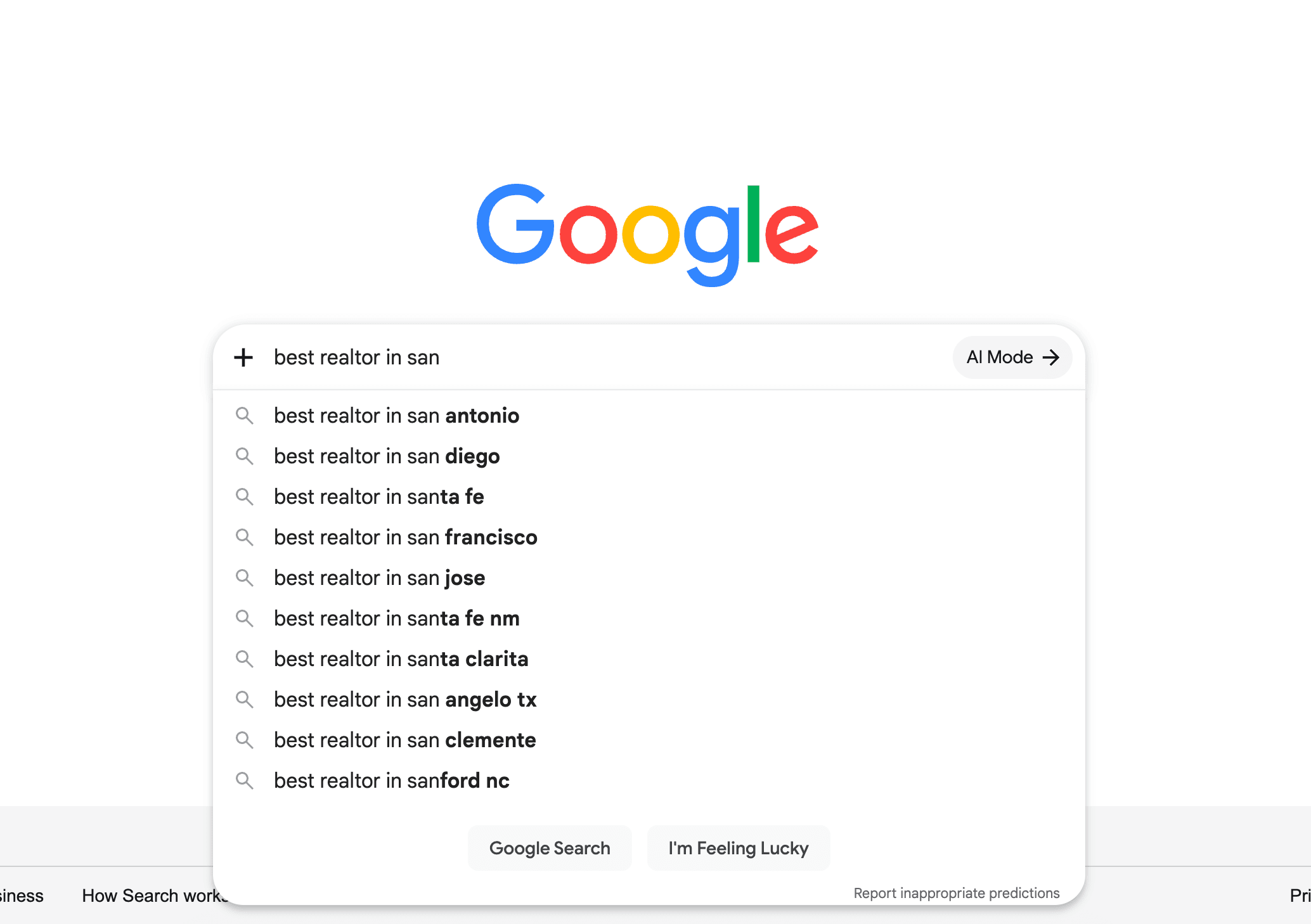
One of the simplest ways to find these types of keywords is to use Google Autocomplete.
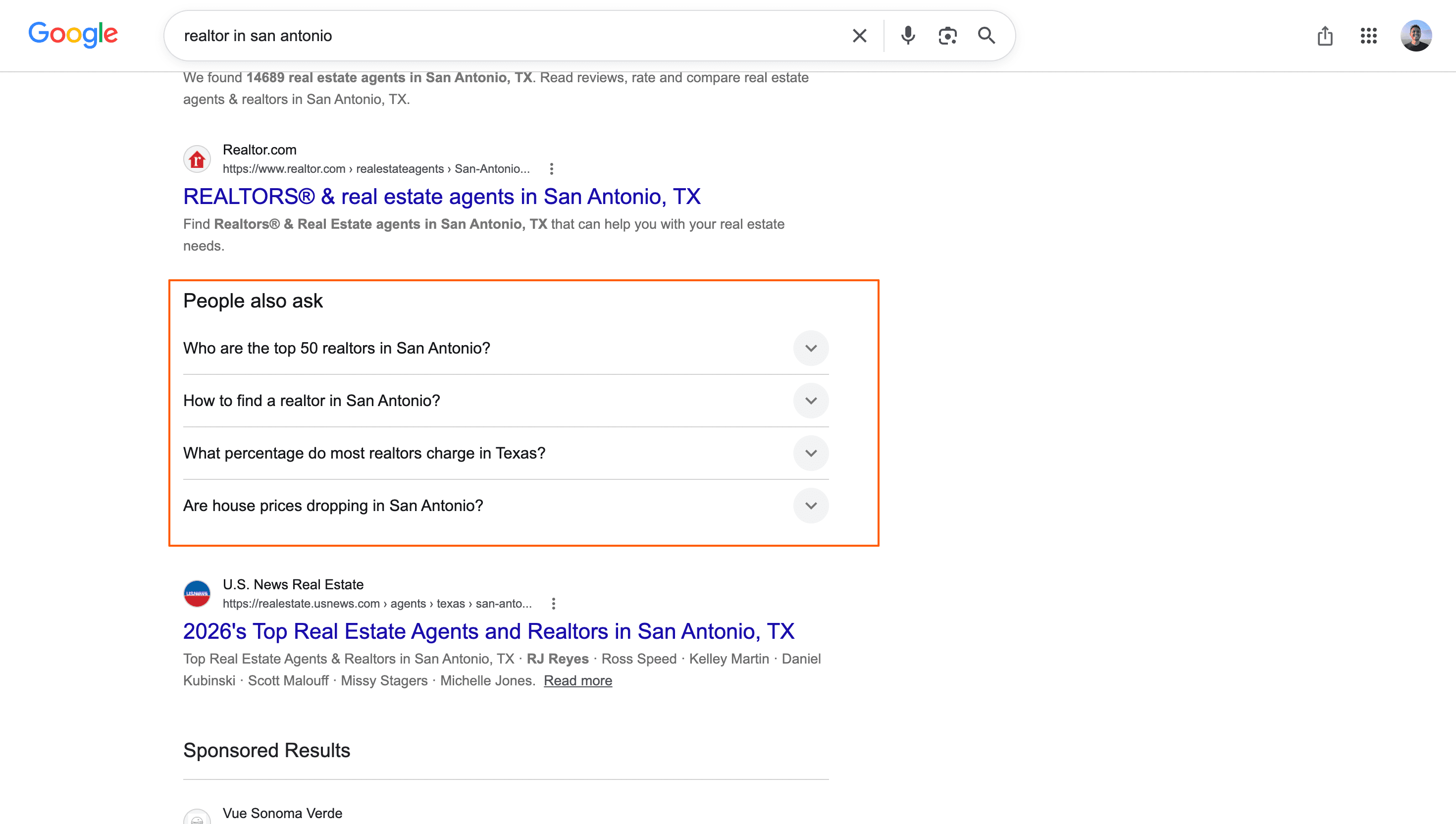
You can also use the People Also Ask section to find questions that people commonly search for around this topic.
2. Optimize each page for one primary intent
Give every important page a single job. A neighborhood page targets that neighborhood. A listing page targets that property type and location. Work your primary term into the title tag, H1, first paragraph, and a subheading, then write naturally for the reader. Keyword stuffing hurts more than it helps. The goal is a page that answers the searcher's question better than anything currently ranking.
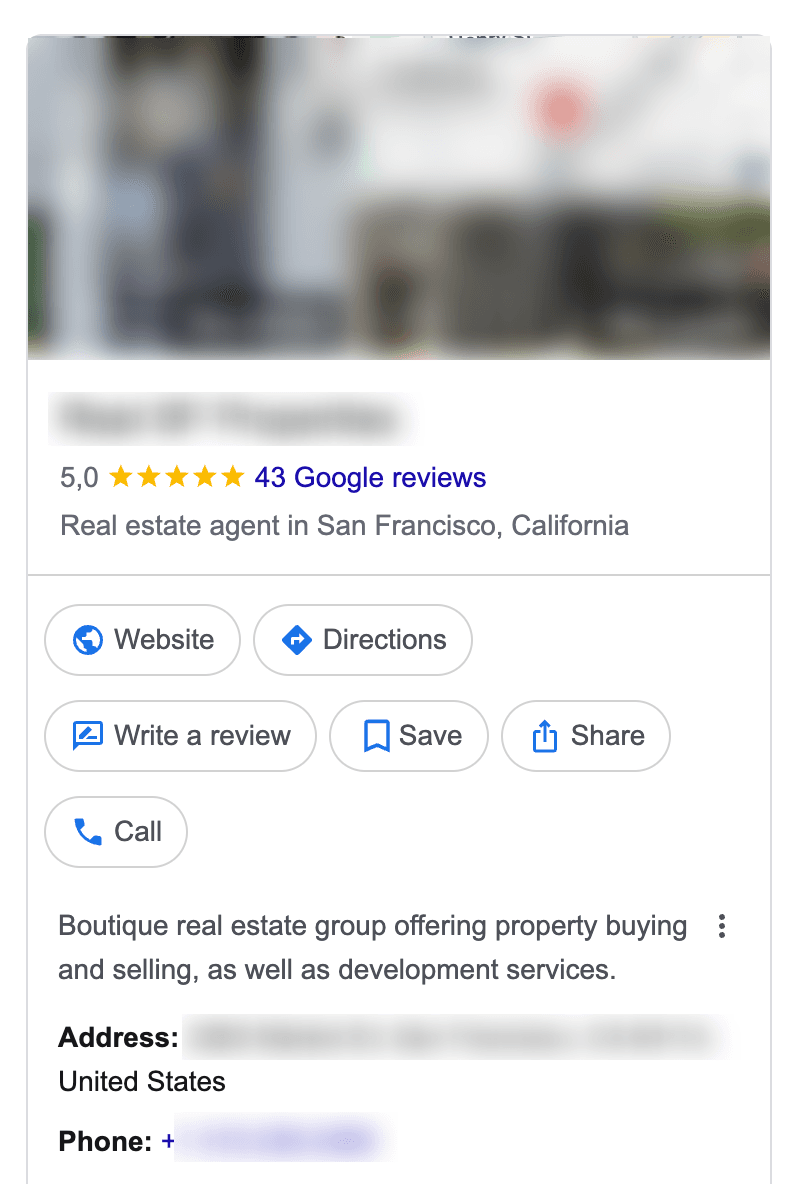
3. Win local SEO and your Google Business Profile
Local intent drives most real estate searches, so your Google Business Profile is critical. Claim it, verify it, and keep your name, address, and phone number identical everywhere they appear online.
Add service areas, post updates, list your specialties, and actively request reviews after every closing. Consistent citations across reputable directories reinforce the local authority signals search engines look for.
4. Build a clean technical foundation
Search engines cannot rank what they cannot crawl. At minimum, confirm your site has a valid SSL certificate, a working XML sitemap, no orphaned pages, and no broken links pointing to sold or expired listings. Fast load times matter here too, because slow pages lose both rankings and impatient buyers. This technical layer is invisible to visitors when it works and painfully obvious when it breaks.
5. Add real estate schema markup
Schema markup is structured code that helps search engines read your content precisely. Two types were built for this industry: RealEstateListing and RealEstateAgent structured data. Marking up a listing lets you hand search engines the price, location, listing date, and property details directly, which improves how your pages appear in results and can help you earn rich features.
6. Publish content that answers real questions
Content is how you rank for the searches that happen before someone is ready to call an agent. Neighborhood guides, buying and selling checklists, market updates, and "cost of living in [city]" pieces all capture early-stage intent and build topical authority. Each piece should target a researched keyword and genuinely help the reader, because helpful content is what earns links, shares, and return visits.
7. Earn local backlinks
A backlink from another site is a vote of confidence. Local backlinks, from a community newspaper, a local business directory, or a neighborhood blog, carry extra weight for real estate because they reinforce that you are an authority in that specific market. Sponsor a local event, contribute a market column, or partner with local businesses to earn them naturally.
8. Optimize for mobile and demonstrate expertise
Most property searches happen on phones, and Google indexes the mobile version of your site first, so a responsive, fast, easy-to-navigate mobile experience is non-negotiable. Alongside that, strengthen your experience, expertise, authoritativeness, and trust signals. Up-to-date About and contact pages, credentials, awards, and real client reviews all tell both searchers and search engines that you are a credible local source.
Why real estate SEO decays faster than most
Here is the part most guides skip. A real estate website is not static. Listings sell, get pulled, or expire every week, and each change is a chance for something to break. A sold listing leaves a dead URL. A theme update slows your page speed. An SSL certificate lapses. An accessibility issue slips in with a new template. None of these send you a warning, and none of them show up in a one-time audit you ran three months ago.
That is the shelf-life problem. A manual SEO audit is a snapshot of a single moment. Because real estate sites churn more than almost any other kind of site, the gap between "audited and healthy" and "quietly losing rankings" opens faster here than almost anywhere else. The checklist above is essential, but it captures one point in time. Staying visible requires knowing the moment something changes.
The table below shows how the most common real estate SEO factors break, why property sites are especially prone to each, and what it costs you in search.
| SEO factor | What typically breaks on a property site | Impact on search |
|---|---|---|
| Broken links | A sold or expired listing leaves a dead URL behind | Wasted crawl budget, lost trust, weaker rankings |
| Page speed | A new theme, plugin, or heavy listing gallery slows load times | Lower rankings and higher bounce on mobile searches |
| SSL and security | A certificate lapses or a security flag appears | Browser warnings that scare off buyers and hurt trust signals |
| Technical SEO | Sitemap, canonical, or indexing issues appear after site edits | Pages fail to get crawled or indexed, so they cannot rank |
| Live-site accessibility | A new listing template ships without alt text or proper contrast | Poorer usability, weaker signals, and added legal exposure |
| Google Business Profile | Hours, details, or reviews fall out of date | Reduced local visibility in the searches that convert best |
Frequently asked questions
What is SEO for real estate?
SEO for real estate is the practice of optimizing a property website so it ranks in organic search results for the terms buyers and sellers use, such as local listing searches, neighborhood queries, and agent searches. It combines local SEO, keyword-targeted content, technical health, and real estate schema markup to turn search into a consistent lead source.
How long does real estate SEO take to work?
Most sites begin seeing meaningful movement in three to six months, with stronger results building over six to twelve months. SEO is a long-term strategy rather than an instant switch, so consistency matters more than any single tactic. Newer sites that focus on low-competition local and long-tail keywords tend to see earlier wins.
Is local SEO the same as real estate SEO?
Local SEO is a major part of real estate SEO, but not the whole of it. Local SEO covers your Google Business Profile, map visibility, and location signals. Real estate SEO also includes listing optimization, property schema markup, content for buyers and sellers, technical site health, and the ongoing monitoring that keeps a fast-changing property site healthy.
What schema markup should real estate websites use?
The two most relevant types are RealEstateListing and RealEstateAgent structured data. Listing schema lets you specify price, location, property details, and listing dates so search engines can display your pages accurately. Agent schema reinforces who you are and where you operate, strengthening your local and trust signals.
Does website accessibility affect real estate SEO?
Yes, indirectly and increasingly directly. Accessible sites are easier for search engines to parse and provide a better experience, which supports rankings. For public-facing real estate sites, accessibility also reduces legal exposure, so monitoring live-site WCAG factors like color contrast, image alt text, and navigation is worth building into your routine.
How often should a real estate website be audited?
A full manual audit every quarter is a reasonable baseline, but real estate sites change too fast for quarterly checks to catch everything. Because listings turn over constantly, continuous monitoring is the practical answer, so broken links, speed regressions, and security issues are caught as they appear instead of at the next scheduled review.
Written by the Kapient team. Last updated: August 18, 2026.