Website Health Score
TL;DR: A website health score is a single number, usually from 0 to 100 or a percentage, that summarizes the overall technical health of a website. It is calculated from the results of many automated checks across areas like performance, security, SEO, accessibility, and broken links, with more serious issues lowering the score more. A higher score means a healthier site. The number is most useful when tracked over time, because a one-time score is only a snapshot of a site that keeps changing.
What Is a Website Health Score?
A website health score is a way to turn a complicated, many-part picture into one number you can actually track. Instead of reading through dozens of separate reports on speed, security, links, and accessibility, you get a single figure that tells you, at a glance, how healthy your site is overall. It is produced by website audit and monitoring tools, which run a battery of checks and roll the results into that one score.
The value is simplicity. A single number is easy to watch, easy to compare against last month, and easy to put in front of a client or a boss. The catch, which we will come back to, is that a health score only means something if you keep measuring it, because the site it describes changes every day..
How is a website health score calculated?
Most tools follow the same basic logic, even if the details differ:
- They run a list of checks across several categories, such as performance, security, SEO, and accessibility.
- Each check either passes or flags an issue.
- Issues are sorted by severity, often as errors, warnings, and notices, with errors counting against the score most heavily.
- The tool combines all of that into one weighted score, where a perfect site scores at or near the top and each unresolved issue pulls the number down.
Because errors weigh more than minor notices, a site can have many small issues and still score well, or a few critical ones and score poorly. That weighting is why the score tracks real risk reasonably well, and also why two tools can disagree.
What factors affect a website health score?
The exact inputs vary by tool, but a comprehensive health score usually draws on the same areas a full monitoring setup watches:
- Performance and speed, including Core Web Vitals and load times
- Security and SSL, such as a valid certificate and no exposed vulnerabilities
- Broken links and crawl errors
- Technical SEO, like indexability, metadata, and structured data
- Accessibility, measured against WCAG, the standard published by the W3C
- Forms and integrations that need to keep working
Each area contributes to the total, so a health score is only as complete as the range of checks behind it. A score based only on SEO says nothing about your accessibility or security, which is why the breadth of what is measured matters as much as the number itself.
What is a good website health score?
Because tools calculate differently, treat these as general guidance rather than an absolute standard. Most tools follow a similar rough scale.
| Score | Rating | What it usually means |
|---|---|---|
| 90 to 100 | Excellent | Few or no significant issues; strong technical health |
| 80 to 89 | Good | Generally healthy with some issues worth addressing |
| 70 to 79 | Fair | A meaningful backlog of issues starting to add up |
| Below 70 | Needs attention | Enough issues, or serious ones, to warrant a focused cleanup |
The more useful question is not "what is my number today" but "which way is it moving." A steady 88 is healthier than a 92 that has been falling for three weeks. Because every website changes constantly, the trend of your score reveals problems long before any single reading does, which is the whole reason to monitor it rather than check it once.
Why a one-time health score is not enough
Here is the limitation of the number on its own. A website health score is a snapshot of a single moment. The instant you check it, your site can change, and the score is out of date. A new plugin slows your pages, an image ships without alt text, a certificate creeps toward expiry, and your real health has dropped even though the score you wrote down last month still looks fine.
That is the shelf-life problem. A score you measured once tells you how healthy your site was then, not now. Its true value only appears when it is measured continuously, so a drop triggers a look before the underlying issue does any damage. A health score you check once a quarter is a number. A health score you monitor is an early warning system.
How Kapient scores and monitors your website's health
This is where a one-time score becomes a live signal. Kapient scans your live site across 74+ technical and quality factors and produces an ongoing website health score, re-checked continuously, so a drop is caught as it happens rather than at your next manual review.
Because Kapient monitors across performance, SSL and security, broken links, technical SEO, live-site accessibility, forms, and more, the score reflects the whole site rather than one narrow slice. And crucially, it does not stop at the number.
When an issue appear, Kapient sends an email alert so you know something changed, and inside the dashboard it gives you a "Recommended fix" button that reveals plain-English, step-by-step guidance tailored to your platform, whether you build on WordPress, Wix, Squarespace, Shopify, or Webflow. So you see not just that your score dropped, but exactly which issue caused it and how to fix it.
For agencies, a clear, trackable health score is also a client-communication asset. It turns invisible technical work into a number a client understands, and a rising or steady score is a simple way to show the value of a website care plan.
A health score is only useful if something is watching it. Kapient scores your site across 74+ factors, monitors it continuously, and hands you the exact fix the moment your score drops. Start monitoring your site with Kapient and turn your health score into an early warning system.
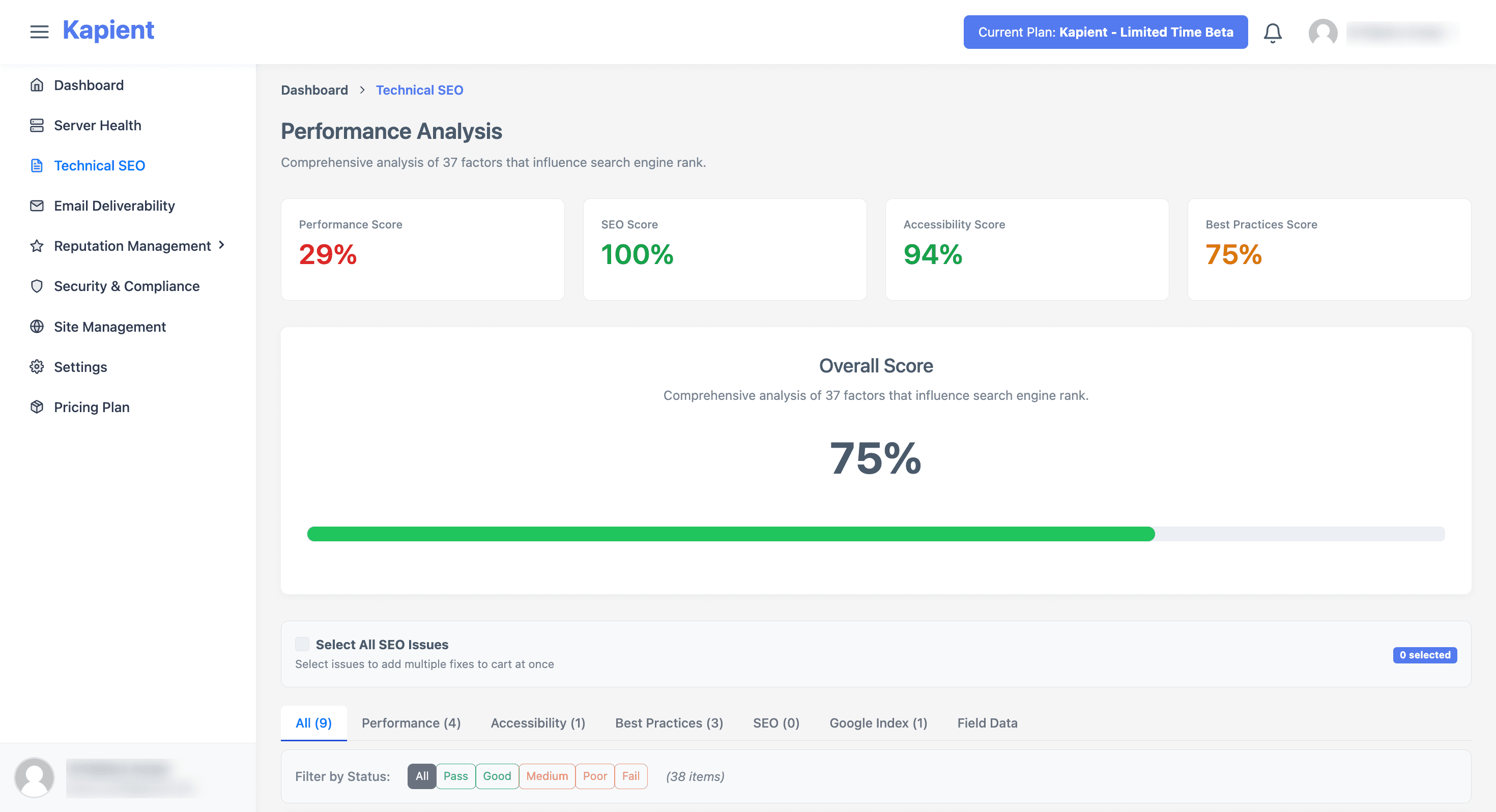
Kapient turns a website health score into a live, monitored signal, with a recommended fix beside each issue that affects it.
Frequently asked questions
What is a website health score?
A website health score is a single number, usually out of 100 or a percentage, that summarizes a website's overall technical health. It is calculated from many automated checks across areas like performance, security, SEO, and accessibility, with more serious issues lowering the score more. It gives you an at-a-glance sense of how healthy your site is without reading every individual report.
How is a website health score calculated?
A tool runs a set of checks, flags the issues it finds, sorts them by severity into errors, warnings, and notices, and combines them into one weighted score. Errors count against the score most, minor notices least. Because each tool checks and weights differently, scores are not directly comparable between tools, so it is best to track one tool's score consistently.
What is a good website health score?
As a rough guide, 90 and above is usually excellent, 80 to 89 is good, 70 to 79 is fair, and below 70 needs attention. Because tools calculate differently, these ranges are general rather than absolute. More important than the exact number is the direction it is moving, since a falling score signals a new problem even while the number still looks acceptable.
What factors affect a website health score?
Common inputs include page speed and Core Web Vitals, SSL and security, broken links, technical SEO like indexability and metadata, accessibility against WCAG, and whether key integrations such as forms are working. The score is only as complete as the checks behind it, so a broad score that covers many areas is more meaningful than one based on a single category.
Does a website health score affect SEO or Google rankings?
A health score itself is not a Google ranking factor, since it is a number invented by the tool that produces it. But many of the things it measures, like page speed, mobile usability, and broken links, do affect rankings and user experience. So improving your health score usually improves the underlying signals that search engines and visitors actually respond to.
How often should you check your website health score?
Ideally continuously. Because a website changes daily, any gap between checks is a window in which the score can drop without you knowing. Continuous monitoring watches the score around the clock and alerts you when it falls, which catches problems far earlier than a manual check every few weeks or months.
Written by the Kapient team. Last updated: September 4, 2026.