Recurring Revenue for a Web Agency: The Playbook for Predictable, Scalable Growth
Every web agency owner knows the project treadmill: land a big build, celebrate, then immediately start worrying about next month because that revenue does not repeat.

Khul Anwar
Growth

TL;DR: Recurring revenue turns a web agency from a feast-or-famine project shop into a predictable, more valuable business. The models that scale best are website care and maintenance plans, managed hosting, monitoring and reporting retainers, and growth (SEO and content) retainers. The difference between an agency that adds recurring revenue and one that scales it is systemization: you can only grow recurring revenue profitably if delivery is standardized and the routine work, especially monitoring, is automated rather than eating your team's hours. Recurring revenue also directly raises what your agency is worth, because buyers pay far more for predictable monthly income than for a project pipeline.
Every web agency owner knows the project treadmill: land a big build, celebrate, then immediately start worrying about next month because that revenue does not repeat. Recurring revenue is how you step off the treadmill. But there is a version of this advice that helps and a version that does not.
The unhelpful version is a list of twelve services you could theoretically sell. The helpful version, which is this guide, focuses on the few models that actually scale for an agency with a team, how to price and deliver them without drowning your people in manual work, and how recurring revenue changes not just your cash flow but the value of the agency itself.
Why Recurring Revenue Matters More for an Agency Than a Freelancer
A solo freelancer builds recurring revenue for stability and to keep the relationship warm. An agency has all of that plus three compounding reasons it matters more.
Predictability funds a team. You cannot hire and keep good people on income that resets to zero every month. A book of recurring revenue is what lets you make payroll commitments and grow headcount without gambling on the next big project landing on time.
It smooths the feast-or-famine cycle that breaks agencies. Project revenue is lumpy and unpredictable. One slow quarter of new business can force layoffs even at a profitable agency. Recurring revenue is the baseline that carries you through the gaps, so a slow sales month is a smaller sales month, not a crisis.
It makes the agency worth more. This is the one most owners underweight. When you eventually sell the agency, or take on investment, buyers value predictable recurring revenue far more highly than an equivalent amount of project income. A business doing $1M in unpredictable project work and one doing $1M with a large recurring base are not worth the same. The recurring base is a multiple of the project pipeline, because it is durable and forecastable. Building recurring revenue is quietly building enterprise value.
If you are a solo operator or just starting out, our companion guide on recurring revenue as a web designer covers the from-scratch version. This post assumes you have a team, or want one, and focuses on what scales.
The Recurring Revenue Models That Actually Scale
There are many services you could sell on retainer. Most agency advice lists all of them. The truth is that a few scale cleanly and the rest are either low-margin commodities or too custom to systemize. Focus your energy on these.
1. Website Care and Maintenance Plans
The foundation, because every site you have ever built needs it and the pitch writes itself: a website is not a thing you buy once, it is a thing you run. A care plan bundles updates, backups, security, monitoring, and support into a flat monthly fee.
For an agency, the advantage over a freelancer is that you can deliver it at scale with standardized processes and tiered pricing. This is the anchor offer most agencies should build first, and we cover exactly what belongs in each tier in our care plan checklist and how to price it in our care plan pricing guide.
2. Managed Hosting
Reselling reliable hosting with your management layer on top adds a recurring line with minimal new skill required, and it locks clients into your ecosystem. The margin on hosting itself is thin, so the mistake is selling it as a standalone commodity clients can price-compare. Bundle it inside a care plan, where you are selling managed peace of mind rather than a server.
3. Monitoring and Reporting Retainers
The highest-margin model, and the one most agencies underuse. Clients do not cancel recurring services because the price is too high. They cancel because nothing appears to happen, month after month, so the value feels invisible.
A monitoring and reporting retainer solves that by making the invisible visible: you continuously watch every client site, catch problems before the client does, and deliver a monthly report proving it. The report is the product. Because monitoring is automatable, the margin is excellent, you are not trading an hour of labor for every hour billed.
4. Growth Retainers (SEO and Content)
For clients who want their site to grow, not just stay alive: ongoing SEO, content, technical improvements, and reporting. This commands the highest rates because it is tied to growth, but it demands the most skill and takes months to show results, so it is the hardest to retain. Start clients on a care plan, earn trust with the basics, then upsell the growth retainer. Our SEO content strategy and SEO metrics guides are the substance of this offer.
The pattern across all four: lead with the care plan as the anchor, layer hosting and monitoring into it, and upsell growth once trust is established. That is a coherent ladder, not a scattered menu.
The Real Constraint: You Can Only Scale What You Systemize
Here is what separates agencies that add a little recurring revenue from agencies that build a real recurring business. It is not the sales. It is the delivery.
Every recurring service you sell is a promise to do work every month, forever, for a growing number of clients. Sell care plans to five clients and your team can wing it. Sell to fifty and, without systems, you have created a monthly avalanche of manual work that consumes your people, erodes your margin, and eventually degrades quality until clients churn. The agencies that plateau are usually the ones whose recurring revenue outgrew their ability to deliver it.
The way through is systemization: standardized service tiers, documented processes, and above all, automation of the routine work. And the single most automatable, most time-consuming part of every recurring web service is the same thing: watching the client's sites.
Consider how much of recurring delivery is just checking. Is the site up? Is the certificate valid? Did the forms still send? Did the update break anything? Did page speed drop? Did anything get indexed that should not be? Across fifty client sites, done manually, that checking is most of a full-time job, and worse, the majority of it finds nothing wrong. It is pure overhead that scales linearly with your client count, which is exactly what kills agency margins as they grow.
How Automation Turns Recurring Revenue Into Real Margin
This is where the economics of agency recurring revenue are won or lost. If a team member has to manually check every client site every week, your monitoring and care plan margins shrink with every client you add. Automate the checking, and the same headcount can serve far more clients, because human time goes only to the sites that actually have a problem.
This is the role Kapient plays in an agency's recurring-revenue engine. It continuously scans every client site across more than 74 technical and quality factors, so your team is not spending its month confirming that nothing is wrong. It watches the things every recurring service promises to cover:
- Uptime, SSL, and security, so an outage or expired certificate is caught in minutes, not when the client calls
- Google Index coverage, comparing sitemap pages against indexed pages, so an indexing problem or a hack surfaces early
- Page speed, broken links, and technical SEO, the health factors that quietly decay between manual check-ins
- Contact form delivery and accessibility, the silent failures manual checks miss
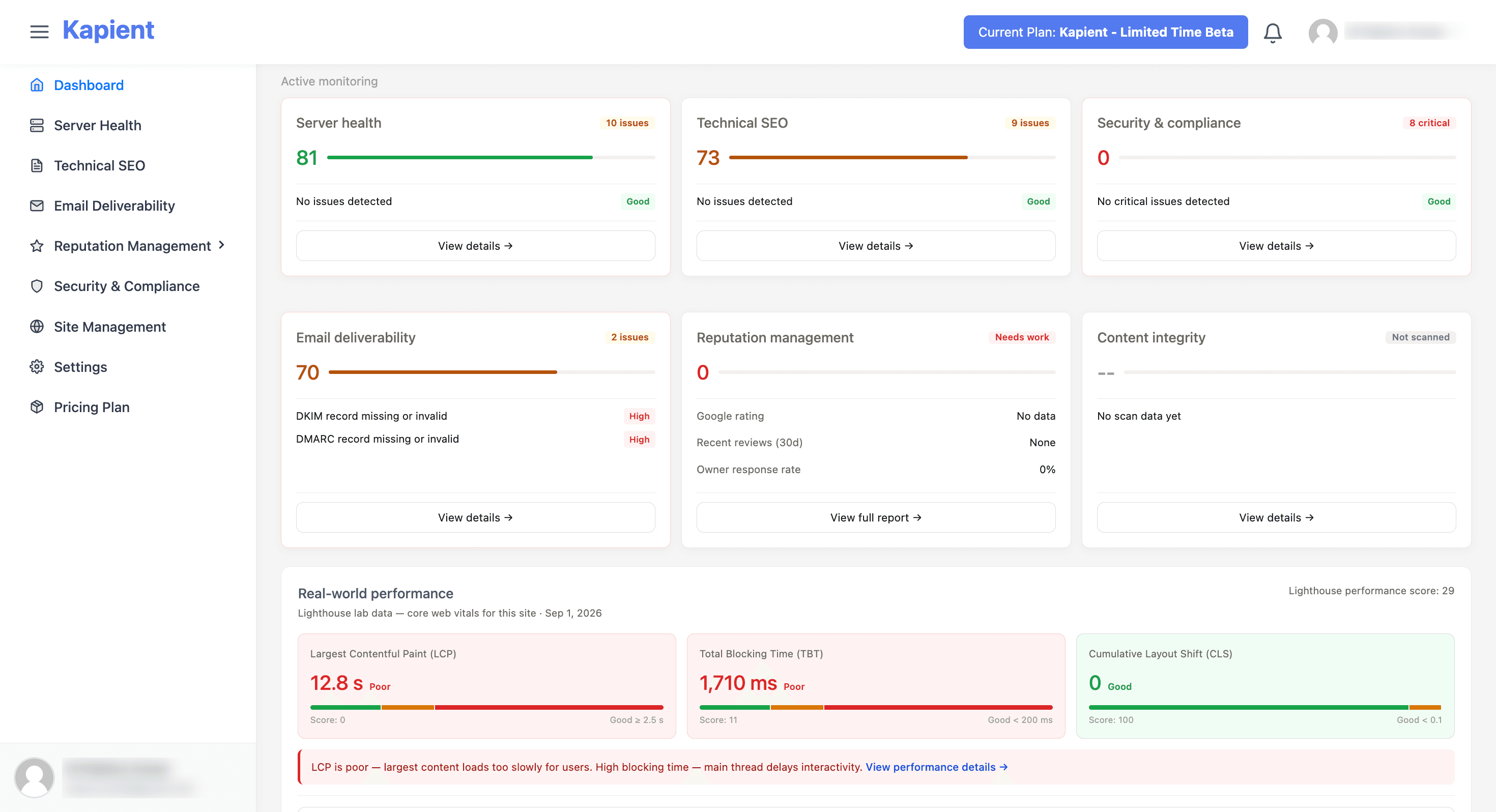
It works the same across WordPress, Wix, Squarespace, and custom builds, so a mixed client portfolio stays on one system. When something breaks, your team gets an email alert, and in the Kapient dashboard the flagged issue carries a "Recommended fix" button with plain-English, stack-specific steps, so resolving it does not require a research detour. And because every scan is recorded, the monthly client report, the thing that keeps retainers from feeling invisible, generates itself instead of costing your team hours per client.
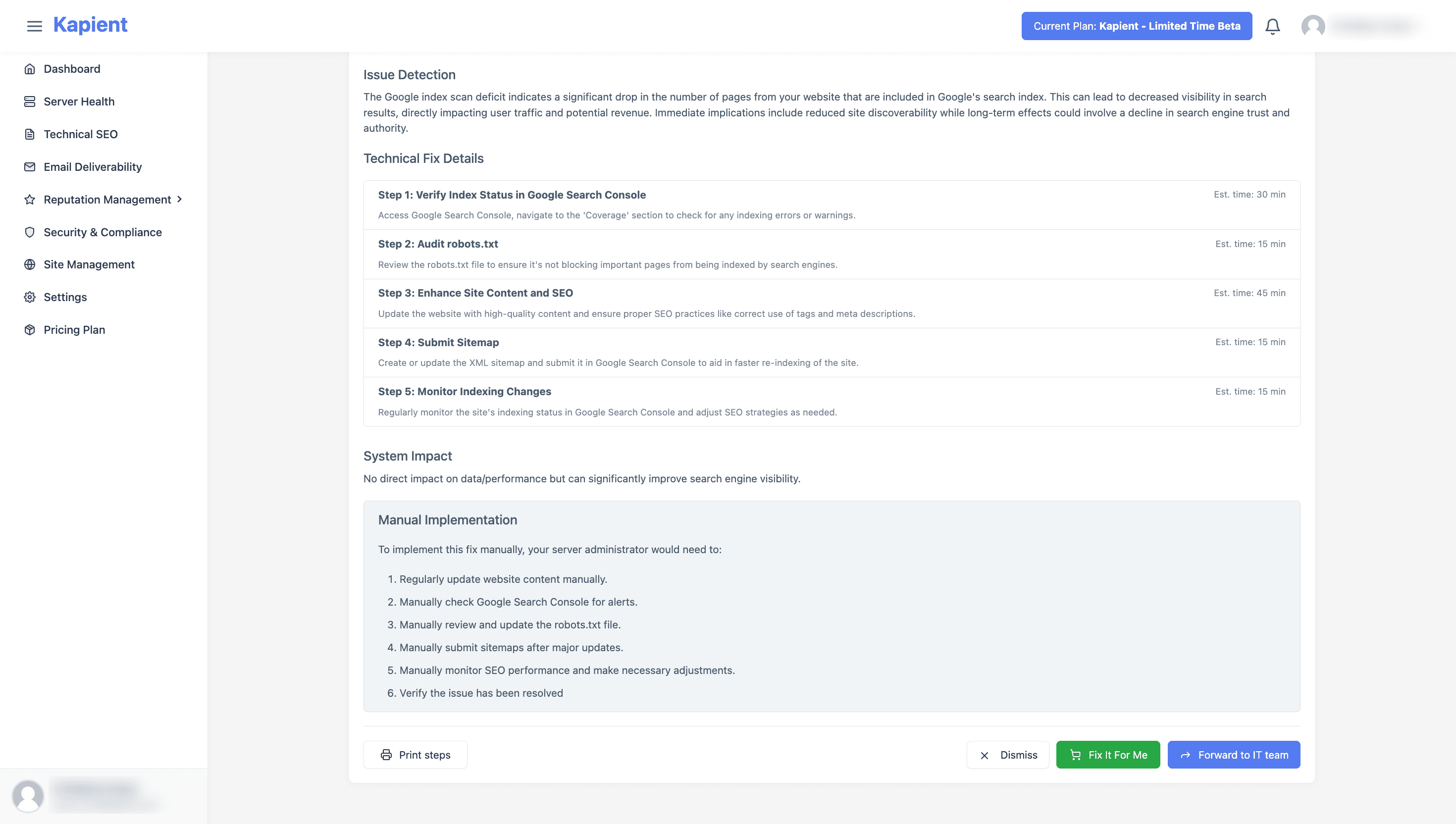
Put together, that automation is what changes the math. It removes the linear per-client overhead that caps most agencies, so adding the fifty-first client costs almost nothing in extra checking time. That is how a monitoring or care plan retainer becomes genuinely profitable at scale, and how one team credibly serves a large book of clients. We break down the client-capacity math in detail in how many client websites one person can manage.
How to Price and Sell Recurring Services
Two principles govern profitable agency recurring revenue.
Price on value and risk, not hours. The value of a care plan is not the hours you spend, it is the disasters you prevent and the peace of mind you provide. Hourly thinking punishes you for being efficient, since a quiet, healthy month becomes a month you feel you overcharged for, when it is actually the best possible outcome. Build tiered packages priced on outcomes, and let automation widen the gap between what you charge and what delivery costs you.
Make it standard, not optional. The agencies that close recurring revenue consistently do not offer maintenance as an add-on at the end of a project. They quote the build and the ongoing plan together, as one thing, framed as how a professional website works. This single reframe is the difference between closing recurring plans occasionally and closing them almost every time, and we cover the full pitch and objection handling in how to sell website maintenance to clients.
Track the Right Number: MRR
Once recurring revenue is flowing, the metric that matters is monthly recurring revenue (MRR), the predictable income you can count on each month. Calculate it by summing what all your recurring clients pay per month (multiply average revenue per client by client count for a quick version). Watch three things: new MRR from new recurring clients, expansion MRR from upsells to existing clients, and churned MRR from cancellations. A healthy agency grows new and expansion MRR faster than churn. A common benchmark for healthy recurring growth is 10 to 20 percent MRR growth month over month in the building phase, though what matters most is that the trend is positive and churn is controlled.
Keeping churn low comes back to the same lever throughout this guide: the monthly report that proves the work, powered by monitoring that catches problems before clients do. Clients who can see the value stay. Clients who cannot, leave.
Recurring revenue only scales if delivery does. Kapient continuously monitors every client site across 74+ technical and quality factors, catches problems before your clients do, and generates the reports that keep retainers alive, so your recurring revenue grows without growing your team's manual workload. Start monitoring free and build recurring revenue that actually scales.
Frequently Asked Questions
What is recurring revenue?
Recurring revenue is income a business earns on a predictable, ongoing basis, rather than through one-off sales. Customers pay at regular intervals (usually monthly or annually) for continued access to a product or service. It is valuable because it is forecastable and stable, which makes a business easier to run, fund, and grow than one that starts from zero every month.
What is recurring revenue for a web agency?
For a web agency specifically, recurring revenue is predictable income from ongoing services rather than one-time project fees: website care plans, hosting, monitoring, and SEO or content retainers. It gives an agency stable, forecastable income that funds a team, smooths the feast-or-famine project cycle, and raises the overall value of the business.
How do I get recurring revenue for my agency?
Start with a website care plan, because every past client already needs one and it is the easiest to sell. Quote it alongside the build as standard rather than an optional add-on, price it on value rather than hours, then layer on hosting, monitoring, and growth retainers over time. Go back to every past client first, they are your warmest leads, since they already trust your work and their sites already need ongoing care.
What businesses have recurring revenue?
Any business built on subscriptions, memberships, retainers, or long-term contracts. Software-as-a-service (SaaS) companies, streaming services, gyms, insurers, and utilities are classic examples. In the agency world, web agencies earn it through care plans and retainers, and any service business can build it by turning one-off work into an ongoing relationship, which is exactly what a care plan does for web work.
What are the best recurring revenue models for a web agency?
The models that scale best are website care and maintenance plans, managed hosting (bundled into care plans), monitoring and reporting retainers, and growth retainers for SEO and content. Care plans are the best anchor offer because every client needs one, and monitoring retainers have the highest margin because the work can be automated. Lead with care plans, then layer the others on.
How much recurring revenue should a web agency aim for?
There is no single target, but many successful agencies aim to cover their fixed costs, payroll, rent, and overhead, entirely with recurring revenue, so project income becomes profit rather than survival. Reaching that point is transformative, because it removes the pressure to win new projects just to keep the lights on. Start by growing recurring revenue to a meaningful fraction of monthly costs and build from there.
Is subscription revenue the same as recurring revenue?
Subscription revenue is one type of recurring revenue, but not the only one. Recurring revenue also includes retainers and long-term contracts that are not strictly subscriptions. For an agency, a care plan is subscription-like, while a monthly SEO retainer or a block of design hours is recurring without being a classic subscription. Both give you the predictability that defines recurring revenue.
What is the difference between revenue and ARR?
Revenue is all the income a business earns in a period, including one-off project fees, one-time sales, and everything else. ARR (annual recurring revenue) counts only the predictable, recurring portion, normalized to a yearly figure. A web agency might have high total revenue in a month it delivered a big build, but its ARR reflects only the care plans and retainers that repeat every year. ARR (and its monthly equivalent, MRR) is what investors and buyers look at, because it is the durable, forecastable income.
How do I calculate MRR for my agency?
Monthly recurring revenue is the total predictable income from all recurring clients in a month. A quick way to calculate it is to multiply your average revenue per recurring client by the number of recurring clients. Track it as three components: new MRR from new clients, expansion MRR from upsells, and churned MRR from cancellations, so you can see whether growth is outpacing churn. Multiply MRR by twelve for a rough ARR figure.
How do I find recurring revenue opportunities in my agency?
Look at what your clients already need but are not getting: maintenance on sites you built, hosting you currently send elsewhere, monitoring nobody is doing, and SEO or content that would help them grow. Every past client is a recurring-revenue opportunity, because their site needs ongoing care whether or not they are paying for it. A website audit of a past client's site is often the easiest way to surface concrete, sellable ongoing work.
Is a web agency good for passive income?
Not exactly passive, but recurring revenue is the closest an agency gets. Care plans and monitoring retainers produce predictable monthly income for work that can be largely systemized and automated, which lowers the ongoing effort per client. It still requires delivery and client relationships, so it is not truly passive, but automating the routine parts (especially monitoring) is what makes recurring revenue approach passive-income economics as you scale.
How does recurring revenue increase the value of my agency?
Buyers and investors value predictable recurring revenue far more highly than one-time project income, because it is durable and forecastable. Two agencies with the same total revenue are not worth the same if one relies on an unpredictable project pipeline and the other has a large recurring base. Building recurring revenue is therefore also building the enterprise value of the agency, which matters if you ever sell or raise capital.
How can my agency deliver recurring services without overloading the team?
Systemize and automate. Standardize your service tiers and processes, and automate the most time-consuming and repetitive part of recurring delivery, monitoring client sites. Continuous monitoring tools watch every site automatically, alert your team only when something actually needs attention, and generate client reports, which removes the per-client manual overhead that otherwise caps how many clients each team member can serve.
Written by
Khul Anwar
Growth
Khulanwar leads content and growth at Kapient, where the team helps small businesses and agencies keep their websites healthy, fast, and compliant. He writes about website monitoring, technical SEO, and the maintenance work that quietly keeps sites from breaking after launch.
Related articles

Website Accessibility for Agencies: Turning Compliance Into a Service
September 16, 2026

How Many Client Websites Can One Freelancer Realistically Manage?
July 23, 2026

10 Common WCAG Failures and How to Fix Them
September 22, 2026
10 Best UptimeRobot Alternatives for 2026
September 10, 2026